FIBT and Kotapay Participate in Roughrider Coin Pilot
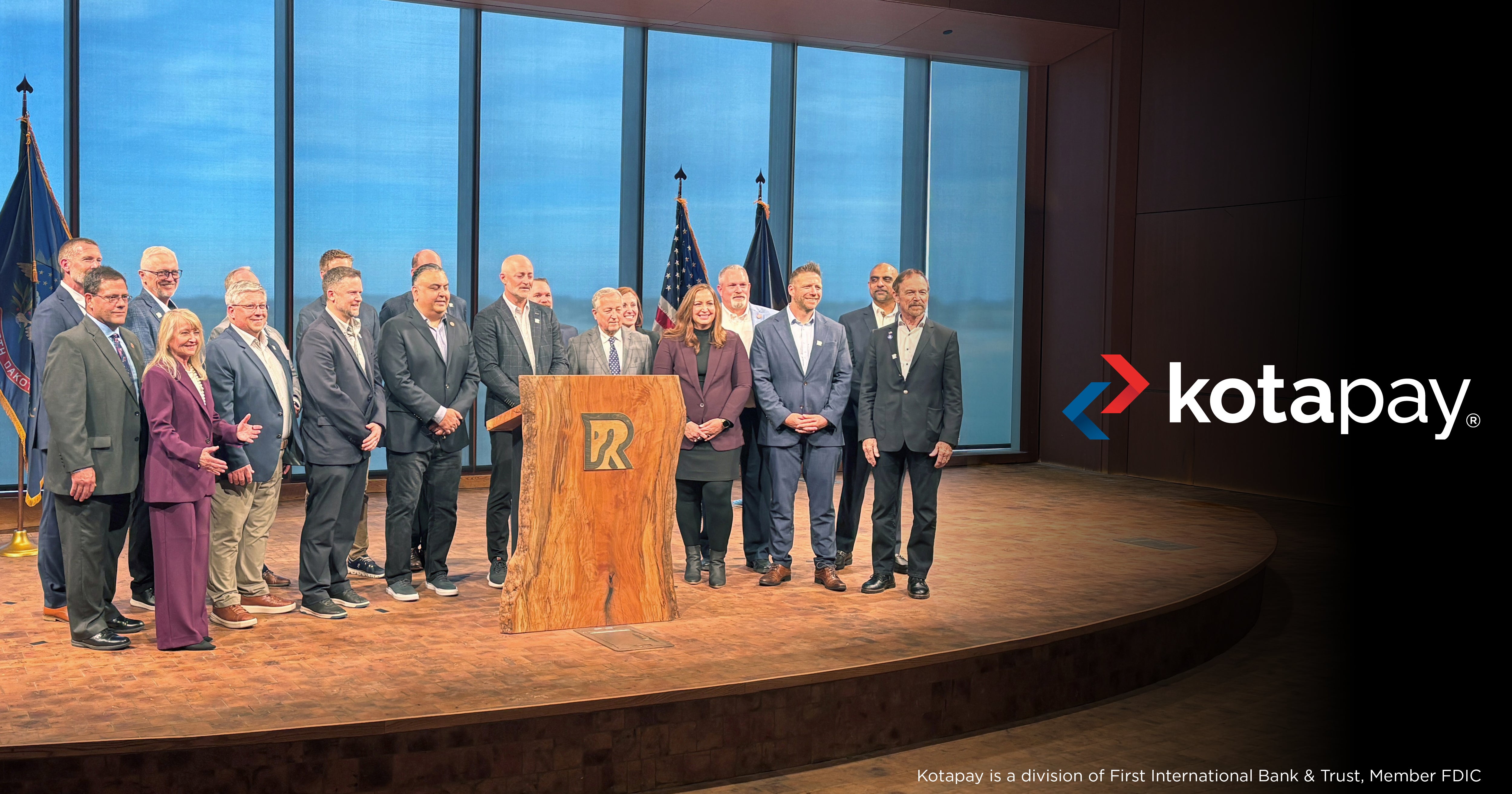
As the payments division of First International Bank & Trust (FIBT), Kotapay participated in Bank of North Dakota’s Roughrider Coin pilot, gaining firsthand experience with blockchain-based bank-to-bank payments. Roughrider Coin is a U.S. dollar-backed digital token designed for use between participating financial institutions.
For Kotapay, the pilot provided an opportunity to evaluate how this emerging technology could complement existing payment methods. We continue to evaluate Roughrider Coin, including its risks, regulatory considerations, and operational implications, before determining how it could fit our operations and customers’ needs.
Understanding Roughrider Coin
Roughrider Coin is a U.S. dollar-backed digital token designed for transactions between participating financial institutions. Each token is backed one-to-one by U.S. dollars and is not available to the public for purchase or trading. The technology uses blockchain to record transactions and enable near real-time settlement. In practical terms, it gives financial institutions another way to move dollar-denominated value within a controlled network.
Despite its name, Roughrider Coin is not a cryptocurrency investment. Its value does not fluctuate like a traditional crypto asset, and its purpose is payment settlement between financial institutions. Kotapay does not offer customers a crypto asset or investment.
Why We Participated
Kotapay has helped businesses move money electronically since 1993 and became part of FIBT in 2018. That experience gives us a practical perspective when evaluating new payment technology: How does it fit with existing operations? Where could it add value? And what new responsibilities or risks does it introduce?
Participating in a controlled pilot allowed us to explore those questions firsthand. Near-real-time settlement could help financial institutions move funds faster, while blockchain provides another way to record and track transactions. But the value of these capabilities depends on how reliably they work and whether they meet real-world needs. As payment needs continue to evolve, exploring emerging infrastructure helps us understand what’s possible and which capabilities deserve further consideration.
Connecting Payments to Contractual Obligations
Blockchain technology could eventually do more than move payments faster. It may also allow payments to be connected to specific conditions through smart contracts. A smart contract is a set of automated instructions that allows a transaction to proceed when predefined conditions are met. For example, a future business payment arrangement could release funds after an authorized party confirms a delivery or approves a completed project milestone.
In this type of transaction, blockchain provides a record of the transaction, while a dollar-backed token represents the value being transferred. Reliable verification that the required conditions have been met would still be essential. These are potential applications of programmable payments, not capabilities currently available through Kotapay.
Applying Familiar Standards to New Technology
New technology doesn’t eliminate payment risk. The controls surrounding it remain essential. Our evaluation includes who can initiate and approve transactions, who can receive funds, how payment conditions are verified, how funds and credentials are protected, and how errors or disruptions are handled.
Regulatory requirements, operational resilience, liquidity, fraud prevention, custody, and financial controls also remain central to the assessment. Any potential gains in speed or automation must be weighed against those responsibilities.
Participating in the Roughrider Coin pilot gave FIBT and Kotapay valuable firsthand experience with an emerging payment technology. We’ll continue evaluating its potential, risks, regulatory considerations, and operational implications as we determine where it may fit. Our focus remains on payment solutions that deliver practical value while meeting the standards our customers expect.